May 15, 2026
8:30a.m. – 4:30p.m.
Elson S. Floyd Cultural Center, Pullman Campus
Breakfast and lunch provided

A biennial statewide symposium showcasing:
- Cutting-edge research across WSU and UW
- Student and trainee “data blitz” presentations
- Networking across research, policy, and public health communities
Our next WSU/UW Joint Cannabis Research Symposium is scheduled to take place on May 15, 2026, in the Elson S. Floyd Cultural Center on the Pullman Campus. Breakfast and lunch will be provided and registration is free!
The online portal to register is now closed. Please contact wsu.ccpro@wsu.edu for late registration.
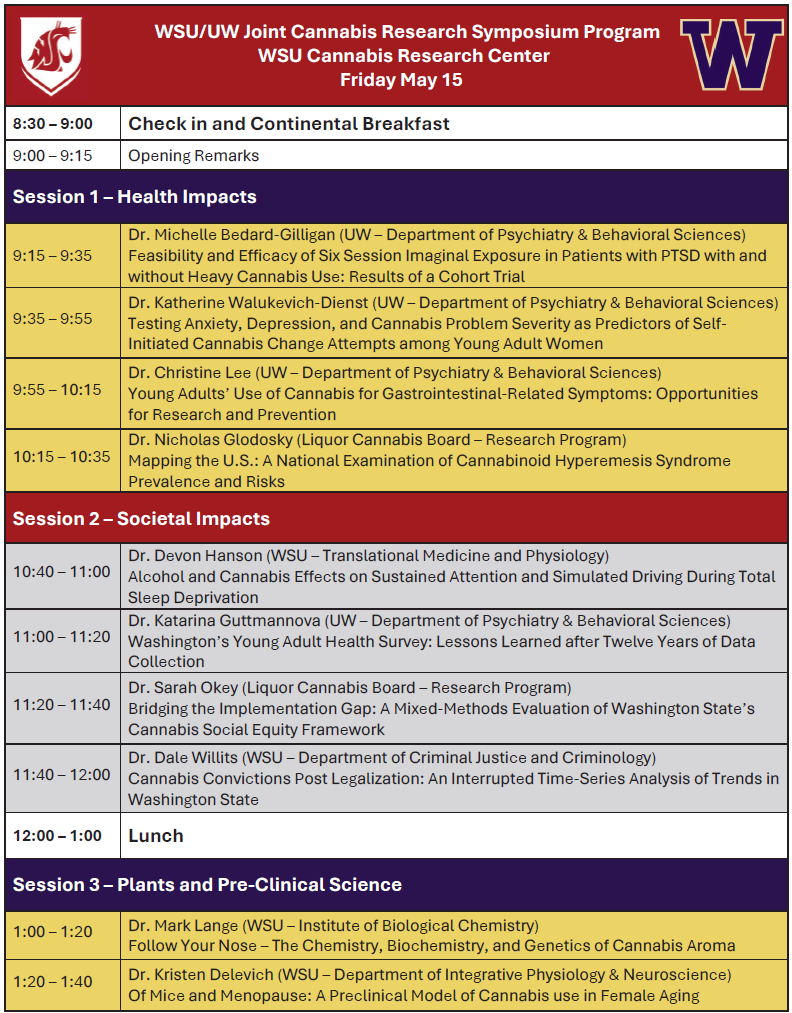
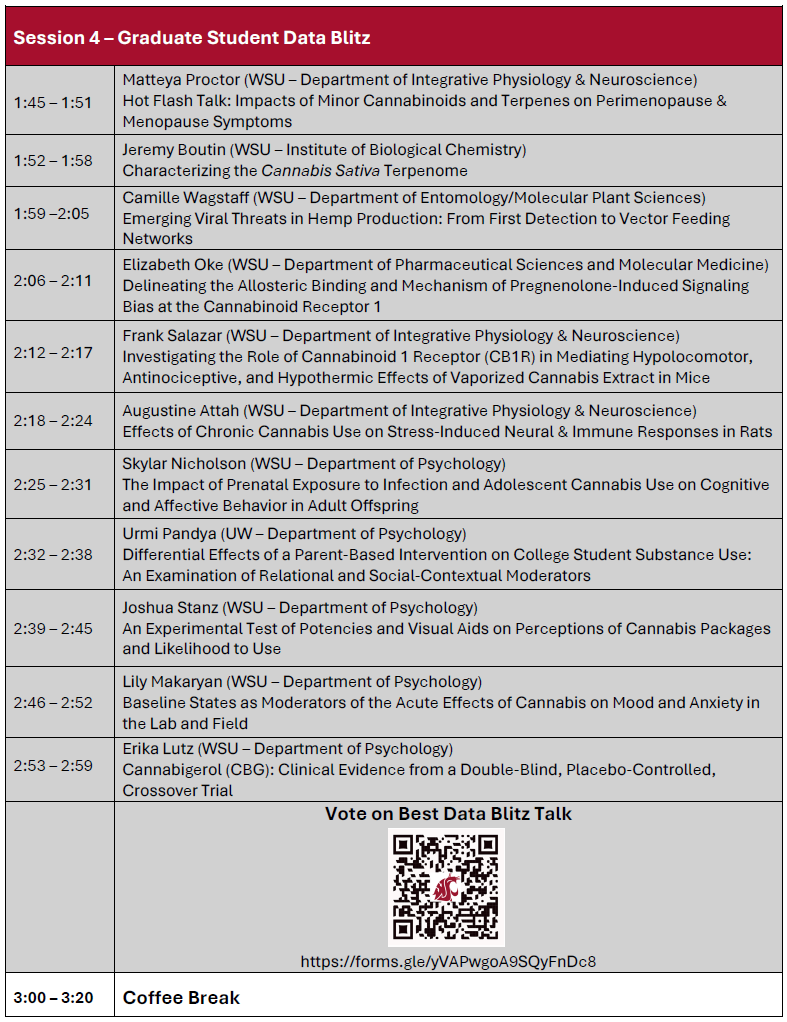
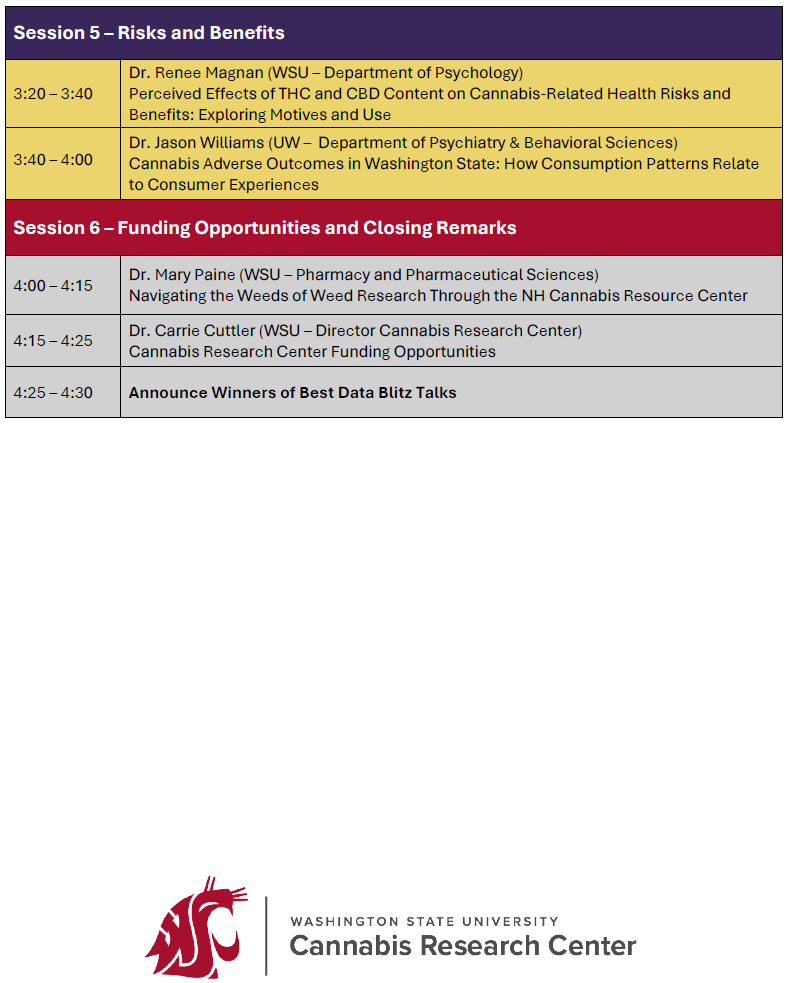
Agenda
Abstracts – Session 1 (Health Impacts)
Authors: Michele Bedard-Gilligan, Cynthia Stappenbeck, Heidi Ojalehto, Richard Ries, Beth Lehinger, and Lori Zoellner
Affiliation: University of Washington
Abstract: Rates of cannabis use in individuals with PTSD are high (Cougle et al., 2011), and patients with PTSD often view cannabis as a viable and effective treatment option for PTSD (Davis et al., 2018). Indeed, cannabis may have positive effects on PTSD symptoms as it can enhance fear extinction (e.g., Rabinak et al., 2013), which is a crucial mechanism of recovery in PTSD. Yet a randomized clinical trial of cannabis as a stand-alone PTSD treatment found it no more effective than placebo (Bonn-Miller et al., 2021). Exposure therapies, which are based on principles of fear extinction learning, are robust and efficacious treatments for PTSD (Watts et al., 2013). However, the effects of cannabis on exposure therapy outcomes have not yet been explored. This pilot cohort trial (NCT02874898) recruited 46 patients with PTSD who were heavy cannabis users (5+ days/week; n = 26) or non-users (n = 20). Patients received five, 60minute sessions of imaginal exposure (six sessions total) over two weeks. Trained interviewers assessed PTSD and substance use at intake, post, and 3-mo follow-up. Self-report measures were given at each assessment and therapy session. There were no baseline differences in PTSD severity by cannabis group. Treatment completion was lower for cannabis users, but still good for both groups: 73.1% cannabis, 90% no cannabis. Among treatment completers, both groups showed reductions in distress across sessions and clinically meaningful improvements at 3-mo follow-up (loss of PTSD diagnosis: 78.9% cannabis, 100% no-use), consistent with extinction. Intent-to-treat analyses and symptom trajectories will be presented. Importantly, in this trial, there was not strong evidence for a facilitation or a detrimental effect of cannabis on PTSD treatment outcomes. These preliminary findings suggest that brief imaginal exposure is feasible and beneficial for PTSD and heavy cannabis use.
Email:mab29@uw.edu
Authors: Katherine Walukevich-Dienst, D. Kang, U. Pandya, C.M. Lee, and C. Dyar
Affiliations: University of Washington and The Ohio State University
Abstract: Self-initiated attempts to reduce or discontinue cannabis use are common among people who use cannabis, yet many attempts are short-lived. Women may be particularly vulnerable to difficulty sustaining change given faster progression to problematic use, more severe withdrawal, and elevated internalizing symptoms. The present longitudinal study examined whether baseline cannabis problem severity and internalizing symptoms (i.e., anxiety and depression) predicted self-initiated cannabis change attempts and withdrawal severity among 600 young adult women. Sexual and gender minority status was tested as a moderator. Across a six-month follow-up, relatively few participants reported being on a current quit attempt or break (11%), and fewer than one in five (18%) reported having engaged in a break that had already ended. Higher baseline cannabis problem severity was associated with a lower likelihood of being on a current quit attempt/break (OR = 0.95, p = .04), but a greater likelihood of having made a prior attempt that had ended (OR = 1.04, p = .04). Depressive symptoms showed a similar pattern, predicting past (OR = 1.63, p = .03) but not sustained current attempts. Baseline cannabis problem severity (b = .11, p < .001), anxiety (b = .40, p <.001), and depressive symptoms (b = .69, p = .002) were associated with greater withdrawal severity among those who attempted a break. Anxiety predicted a higher likelihood of being on a current break among gender minority participants (OR = 2.94, p = .02). Findings highlight internalizing symptoms and cannabis-related problems as potential barriers to sustaining quit/break attempts. Addressing internalizing symptoms and withdrawal may help sustain cannabis quit/break attempts among women.
Email: kwd1@uw.edu
Authors: Christine M. Lee, Anne M. Fairlie, and Brian H. Calhoun
Affiliation: University of Washington
Abstract: Cannabis is a widely used psychoactive substance among young adults (YAs, 18-29 year olds). Recent estimates show 42.4% of YAs used cannabis in the past year and 10.4% used daily/near daily (20+ occasions in past 30 days). Cannabinoid Hyperemesis Syndrome (CHS) is an emerging public health problem characterized by recurrent, severe, cyclical vomiting and severe nausea and abdominal pain in people with chronic, long-term, and/or high dose cannabis use and is increasingly reported in emergency departments and recently recognized by an ICD code. Prior to active CHS, people are in a prodromal phase characterized by mild or intermittent nausea and abdominal discomfort lasting months to years. Often, cannabis use is sustained or increased during this phase due to not associating symptoms with use and belief that cannabis may help alleviate gastrointestinal (GI) symptoms. We will discuss YAs’ use of cannabis for symptoms that may be associated with prodromal stage of CHS. Given limited research in this area, we will present data from a sample of YAs aged 18-29 (N = 200, 61.0% female, mean age = 22.86 (SD=2.90)) who used cannabis 15+ days in past month at screening in order to document the occurrence of using cannabis for GI-related symptoms and cannabis outcomes. Descriptive results indicate 63.5% (n=127) reported using cannabis for poor appetite, nausea, and/or pain with 16.5% (n=33) using for all three conditions. Moreover, 26.5% reported using cannabis for poor appetite and nausea. YAs who reported using cannabis for 1+ conditions had significantly higher cannabis-related outcomes on average than those who did not use cannabis for any of the 3 conditions, e.g., 27.17 (SD=17.25) hours high in typical week versus 18.92 (SD=12.66) hours and 17.29 (SD=4.99) cannabis use disorder symptoms versus 14.40 (SD=5.38). Discussion will focus on implications for research and extending current motivational models of use.
Email: leecm@uw.edu
Authors: Nicholas C. Glodosky and Sarah A. Okey
Affiliation: Washington State Liquor and Cannabis Board
Purpose: As cannabis legalization increases across the United States (U.S.), so do concerns around adverse consequences of cannabis use. Cannabinoid hyperemesis syndrome (CHS) is an emerging and understudied medical complication characterized by intense nausea, abdominal pain, and cyclical vomiting that typically follows heavy, chronic cannabis use. The purpose of this study was to examine the prevalence and potential risk factors for CHS in a national sample of cannabis users.
Methods: Survey data were collected by the International Cannabis Policy Study in 2023. Among participants reporting past-year cannabis use, the prevalence of CHS was calculated and logistic multilevel modeling was used to test a-priori hypotheses for factors associated with CHS.
Results: 10,255 participants (45.82% female, Mage = 39.46 years) were included in this study. Approximately 6% reported past-year CHS. Participants who were younger, male, Hispanic, or two or more races were more likely to report CHS. Older age of first cannabis use, more frequent use of cannabis edibles and concentrates, riskier cannabis use patterns, and past-year alcohol use were also associated with higher risk. Those who grew their own cannabis, used cannabis to manage symptoms of headaches/migraines or nausea/vomiting, or experienced bipolar disorder or psychosis/dissociative identity disorder were also more likely to report CHS. CHS was less likely to be reported among individuals who used more cannabis flower, used cannabis for lack of appetite, or experienced depression. There was no significant effect of the legal status of cannabis between states.
Conclusions: This was the largest examination of nation-wide prevalence estimates and risk factors of CHS to date. We identified certain types of cannabis products, use patterns, and underlying medical and psychiatric disorders that may be associated with increased risk for developing CHS. Ongoing surveillance, standardized definitions, and identification of underlying risk factors are essential to enhance awareness and accurate diagnosis.
Email: nick.glodosky@lcb.wa.gov
Abstracts – Session 2 (Societal Impacts)
Authors: Devon A. Hansenand Matthew E. Layton
Affiliation: Washington State University
Introduction: Total sleep deprivation (TSD) is common due to long work hours and competing time demands. In laboratory settings, TSD display highly reproduceable profiles of neurobehavioral impairment, but in real-world settings it is often co-occurs with alcohol and cannabis use. This pilot study investigated the effect of substance intake on two aspects of neurobehavioral performance, sustained attention and simulated driving in response to TSD.
Methods: Six healthy mean (ages 23-37y) completed two 24h in-laboratory visits separated by ≥1 week. During each visit, they were kept awake from 15:00 until 06:00 the next day, and they completed a 10min Psychomotor Vigilance Task (PVT) and high-fidelity driving simulation sessions every 2-3h, followed by an 8h recovery sleep opportunity. During the second visit, participants were randomized to receive sublingual cannabis at 22:30 or alcohol at 23:30. PVT mean RT, number of lapses (RT>500ms), false starts, and driving metrics (mean lane deviation and mean braking latency) were analyzed using mixed-effects regression.
Results: PVT and simulated driving performance deteriorated during the second half of the night for all metrics (F>3.6, P<0.002). Alcohol increased mean RT (F=4.9, P=0.002) and lapses (F=7.7, P<0.001) but not false starts (F=1.0, P=0.41) on the PVT but did not significantly affect driving performance (F<2.64, P>0.06). Cannabis did not significantly affect mean RT (F=0.9, P=0.46), lapses (F=1.1, P=0.37), or false starts (F=0.8, P=0.56) on the PVT, but did significantly increase mean lane deviation (F=5.01, P<0.01), without affecting mean braking latency (F=0.97, P=0.41).
Conclusions: Alcohol exacerbated neurobehavioral impairment during TSD on the PVT but did not worsen simulated driving. Cannabis did not further impair PVT performance but did increase mean lane deviation on the driving simulation. These preliminary findings suggest that commonly used drugs such as alcohol and cannabis may amplify neurobehavioral impairment from sleep loss, which has critical implications for driving and other safety-sensitive activities.
Support: National Safety Council
Email: devon.hansen@wsu.edu
Authors: Katarina Guttmannova, Rhew, Larimer, Lambuth, Lyles-Riebli, and Kilmer
Affiliation: University of Washington
Purpose: The Young Adult Health Survey has been funded by Washington’s Division of Behavioral Health and Recovery since 2014, primarily to measure the impacts of cannabis legalization yet also to monitor substance use and mental health trends among young adults in Washington. With such a rich data set, secondary data analysis grants have allowed for an in-depth examination, resulting in many publications and important findings.
Methods: Each year, a cross-sectional sample of 18- to 25-year-olds are invited to participate in the survey through direct mail invitations from a random sample from Washington’s Department of Licensing as well as through social media advertising. Additionally, select longitudinal cohorts are invited to follow-up, affording the opportunity to examine changes over time. In 2025, the 12th cohort of young adults was recruited (n=1,228), bringing the overall sample to 21,690 unique participants over 12 years.
Results: Findings from the 2025 (12th cohort) are currently being conducted, though recent findings from 2024 demonstrated a significant increase over time in past-year, at least monthly, at least weekly, and daily non-medical cannabis use, largely driven by 21- to 25-year-olds. Reported medical cannabis use has significantly declined over time, similar to other substance use. Secondary data analysis has resulted in publications focused on diverse topics including cannabis use and retail outlet availability, the role of neighborhood disadvantage, trends over time for multiple substances, risk factors for use, cross-substance associations, impaired driving, and changes during the COVID-19 pandemic.
Conclusions: Cannabis use by young adults, particularly those with access to the legal market, has increased after the opening of retail stores. Along with lessons learned from numerous peer-reviewed publications, clear opportunities exist for prevention and intervention.
Email: kg27@uw.edu
Authors: Sarah A. Okey and Nicholas C. Glodosky
Affiliation: Washington State Liquor and Cannabis Board
Purpose: Since the legalization of adult-use cannabis in 2012, Washington State has worked to refine its regulatory framework to better address the disproportionate harms of the War on Drugs. As a result, the Washington State Legislature established the Social Equity in Cannabis Program via E2SHB 2870 (2020) and expanded the program in E2SSB 5080 (2023). This study examines the state’s progress in lowering barriers to entry for disproportionately impacted individuals and identifies the structural obstacles that continue to delay equitable market participation.
Methods: Pursuant to E2SSB 5167, this review employed a mixed-methods approach integrated with an innovative artificial intelligence (AI)-supported analysis. Data sources included the Cannabis Central Reporting System (CCRS), stakeholder surveys, key informant public feedback, and a review of peer-reviewed and government literature. This multifaceted methodology allowed for an efficient, resource-conscious evaluation of program outcomes.
Results: As of September 2025, significant implementation gaps persist. Only 25% of eligible social equity applicants approved in 2023 have successfully secured physical locations and 16% reported sales data in the first quarter of 2025. Analyses identified three primary barriers to success: (1) inability to secure retail locations due to local prohibitions in 81 cities and six counties; (2) inadequate startup capital exacerbated by federal Schedule I status; and (3) a highly competitive market where over half of operational social equity retailers fall below long-term sustainability thresholds.
Conclusions: Although Washington has transitioned toward a more intentional social equity framework, several hurdles remain. Proposed policy options include increasing grant funding, broadening eligible expenses, and expanding license types (e.g., delivery and hospitality) to mitigate market saturation. All solutions require significant support from both the legislature and diverse stakeholder interests. Future research is essential to develop strategies that effectively work towards developing fiscally responsible solutions that support the long-term viability of the program and its participants.
Email: sarah.okey@lcb.wa.gov
Authors: Dale W. Willitsand Mikala Meize-Bowers
Affiliations: Washington State University, Washington State Center for Court Research
Abstract: A substantial body of work has explored the consequences of recreational cannabis legalization on offenses post-legalization. A smaller but growing body of research has explored the link between cannabis legalization and cannabis-related offenses over time, with much of this work focused on trends in racial disparities following legalization. This work shows that cannabis arrests decline post legalization, but racial disparities tend to remain. Qualitative work on cannabis legalization suggests that one reason why arrests decline is because law enforcement professionals do not believe prosecutors will pursue these cases. Quantitatively, however, convictions in the wake of legalization have not been explored. The current study explores conviction trends following legalization in Washington State. Results demonstrate that convictions decline for both adults and youth following legalization, though importantly, the decline is not statistically significant for Black youth.
Email: dale.willits@wsu.edu
Abstracts – Session 3 (Plants and Pre-Clinical Science)
Author: B. Mark Lange
Affiliation: Washington State University
Abstract: Cannabis (Cannabis sativa L.) is renowned not only for its psychoactive and therapeutic properties but also for its distinctive and complex aroma. This aroma is produced by a diverse array of volatiles, including terpenoids, esters, aldehydes, alcohols, and sulfur-containing compounds (VSCs). For example, the “gassy” or “fuel-like” aroma characteristic of certain cannabis chemotypes is a highly sought-after trait of specific genetic lineages such as OG Kush and Sour Diesel, and this main body note is imparted by terpenoids and non-terpenoid volatiles. “Skunkiness” is a distinctive, sulfurous, and intensely pungent smell found prevalent across cannabis chemotypes. While revered by many consumers, it is often considered a nuisance odor of cannabis cultivation. Recent research has shown that VSCs such as 3-methyl-2-butene-1-thiol are key contributors to this characteristic odor. Other VSCs underlie exotic and fruity notes, with important contributions to a wide range of aroma characteristics. These sulfur compounds are present in very low concentrations but have extremely low odor thresholds, meaning that even trace amounts can significantly influence a chemotype’s aroma. This presentation will discuss the progress that has been made in recent years toward unraveling the biosynthetic origins of various types of cannabis volatiles, with an emphasis on terpenoids and VSCs. An overview will be given on how this information is integrated into aroma-forward breeding programs.
Email: lange-m@wsu.edu
Author: Kristen Delevich
Affiliation: Washington State University
Abstract: Cannabis use is increasing among peri- and postmenopausal women, yet its biological effects in the menopausal state remain largely unknown. This is a critical gap, as menopause is associated with increased adiposity, altered energy balance, mood disturbances, and cognitive changes, all of which may be influenced by cannabinoid signaling. We are currently using a mouse model to test how age and ovarian hormone loss shape the consequences of chronic cannabis exposure across metabolic, behavioral, and neural domains.
Young adult (postnatal day 90) and aged (18 month) female mice underwent ovariectomy or sham surgery and after 1 week of recovery received daily exposure to THC-dominant whole-plant cannabis vapor, vehicle vapor, or room air (30 min) for three weeks. Beginning the week prior to surgery and throughout exposure, we monitored food intake and locomotor activity continuously in the home cage while tracking weight and body composition. We found that cannabis exposure selectively accelerated early post-surgical weight gain in young adult OVX but not ovarian intact mice, resulting in a time-dependent divergence in weight trajectories. Ongoing analyses of feeding and activity patterns will determine the behavioral mechanisms underlying this effect. Following exposure, mice were assessed on assays of anxiety-like and depression-related behavior and a cognitive flexibility task, with analyses in progress.
We hypothesize that aging and ovarian hormone loss modify cannabis pharmacokinetics and behavioral sensitivity, leading to state-dependent effects on energy balance and affective and cognitive outcomes. Ongoing studies are testing whether these effects are accompanied by shifts in excitatory/inhibitory balance within the medial prefrontal cortex, a key regulator of emotion and cognition that is sensitive to both aging and ovarian hormone loss. Together, this work will provide foundational insight into how cannabis use interacts with menopause-related biology and inform strategies to support healthy aging in females.
Email: kristen.delevich@wsu.edu
Abstracts – Session 4 (Graduate Student Data Blitz)
Authors: Matteya A. Proctor, Erika T. H. Lutz, Ethan Russo, Carrie Cuttler and Ryan McLaughlin
Affiliation: Washington State University
Abstract: The menopausal transition is associated with several adverse symptoms, and most approved treatments rely on hormonal therapy, which can carry significant side effects and risks. Many midlife women report using cannabis to manage perimenopause- and menopause-related symptoms, yet the effects of cannabinoids on these symptoms remain largely unexplored. Prior work suggests cannabinoids may alleviate symptoms commonly reported during menopause, including anxiety, pain, and depression. Thus, assessing the therapeutic potential of cannabinoid products addresses a critical public health gap and may meaningfully inform symptom management decisions.
We conducted a longitudinal, double-blind, placebo-controlled clinical trial to evaluate the effects of a hemp-derived formulation containing minor cannabinoids (e.g., CBD, CBG) and terpenes on physical, emotional, and cognitive menopause symptoms. Healthy midlife women (n=100) were randomized to cannabinoid or placebo conditions and completed symptom and cognitive assessments, including twice-daily ecological momentary assessments (EMAs), across three months. The first month served as a no-treatment baseline, followed by two months of twice-daily oral product use.
Preliminary mixed factorial ANOVAs revealed two significant product x time interactions and several main effects of time, but no main effects of product. Follow-up analyses indicated that the placebo group reported higher depression severity than the cannabinoid group during the baseline month, and the cannabinoid group showed increased false recall of unrelated words on a false memory task after starting treatment. Side effects were minimal, did not differ by condition, and neither group reported intoxication or impairment.
Interpretation of these predominantly null findings is limited by analytic constraints, as month-level ANOVAs oversimplify the longitudinal EMA data. Thus, we are reanalyzing the data using multilevel modeling, which offers a more sensitive approach to detect effects. Given increasing cannabis use among midlife women and gaps in current menopause treatments, continued research on cannabinoid-based interventions remains essential to advancing women’s health.
Email: matteya.proctor@wsu.edu
Author: Jeremy Boutin
Affiliation: Washington State University
Abstract: While numerous terpenes have been identified in Cannabis sativa and are routinely screened for by commercial cannabis testing labs, clear knowledge gaps exist in their synthesis and biological importance. To date, 55 terpene synthases (TPS) have been identified across dozens of Cannabis chemovars, however, only thirty of which have been functionally characterized. Historically, the identification and subsequent functional characterization of TPS relied on the availability of incomplete reference genome assemblies, leading to overlooked or misidentified TPSs. Recently, a published cannabis pangenome, composed of 193 different genomes, has allowed for the identification of more than 50 unique TPS gene targets. BLAST searches with previously characterized TPSs were used to identify loci within the cannabis pangenome with high sequence identity and the Clustal Omega algorithm was employed to generate an alignment of all putative TPS loci. Synthetic open reading frames of 12 unique TPS sequences were subcloned into a pET28B expression vector and expressed heterologously in E. coli. Resulting recombinant proteins were purified and assayed with geranyl pyrophosphate and farnesyl pyrophosphate to test novel monoterpene and sesquiterpene synthase activity, respectively. This project aims at better understanding the chemical diversity of terpenes in Cannabis by identifying and functionally characterizing novel TPSs from the Cannabis pangenome. Such knowledge allows inferences about the origin and regulation of chemical diversity, which is pertinent for appreciating the role of terpenes in imparting aroma characteristics but also for aiding commercial efforts that harness the accumulation of terpenes for the food, cosmetic, and pharmaceutical industries.
Email: jeremy.boutin@wsu.edu
Author: Camille Wagstaff
Affiliation: Washington State University
Abstract: Hemp production faces a growing challenge: emerging insect-vectored pathogens in a system with limited pesticide options. Some of the most pressing threats are vectored by beet leafhopper (Circulifer tenellus), a highly mobile insect capable of moving between crops and surrounding vegetation. Despite its established impact in other western cropping systems, the epidemiology of leafhopper-vectored pathogens in hemp remains poorly characterized.
Here, we documented the first confirmed incidences of leafhopper-associated pathogens beet curly top virus (BCTV) and ‘Candidatus Phytoplasma trifolii’ in cannabis in Washington state, establishing baseline records for this emerging agricultural industry. These detections signal a shifting pathogen landscape and emphasize the need for early surveillance and integrated management strategies.
To determine hemp’s vulnerability to BCTV, greenhouse transmission assays were conducted by exposing hemp plants to viruliferous leafhoppers under controlled conditions. Infection was successfully established, symptom progression was documented, and impacts on plant vigor were quantified. These experiments provide direct evidence that hemp is a competent host for BCTV and underscore the potential risk to fiber production systems, reinforcing the need for proactive management strategies.
Concurrently, to better understand field-level transmission risk, we monitored and collected leafhoppers from around hemp fields for molecular gut content analysis using long-read SMRT sequencing (PacBio) to reconstruct plant feeding histories and PCR for pathogen identification. By detecting alternative host plants of infected leafhoppers across agricultural and non-crop habitats, this work aims to clarify landscape reservoirs that may facilitate pathogen spillover into hemp.
Our sampling focused on expanding our knowledge of Washington hemp epidemiology by including intensive leafhopper collections from hemp systems in Idaho and Colorado to refine regional host-use networks and transmission risk models. Together, this research links first pathogen detection, controlled greenhouse validation, and molecular ecology to support science-based, sustainable hemp production in the Western U.S.
Email: camille.wagstaff@wsu.edu
Authors: Elizabeth D. Oke, Sophia Kozlova, and Senthil Natesan
Affiliation: Washington State University
Abstract: Cannabis is one of the most widely used psychoactive substances worldwide, and its increasing use has contributed to rising rates of cannabis use disorder (CUD). CUD is characterized by chronic cannabis consumption that leads to clinically significant behavioral and functional impairment. The psychoactive effects of cannabis are primarily mediated through activation of cannabinoid receptor 1 (CB1) by Δ⁸-tetrahydrocannabinol (THC). CB1 belongs to the G proteincoupled receptor (GPCR) family. GPCRs can exhibit functional selectivity, adopting different conformational states that preferentially activate distinct intracellular signaling pathways (G proteins or β-arrestins).
Pregnenolone, an endogenous steroid, acts as a signaling-specific allosteric modulator of CB1. It selectively inhibits THC-induced activation of the mitogen-activated protein kinase (MAPK) pathway while leaving cyclic adenosine monophosphate (cAMP) signaling largely unaffected. As a result, pregnenolone can block several behavioral and psychological effects of THC, offering a promising approach for the treatment of cannabis addiction and CUD. AEF0117, a clinically advanced pregnenolone analog with an improved pharmacological profile, exhibits similar pathway-selective activity. However, the precise binding site at CB1 and the molecular mechanism responsible for this signaling-specific allosteric inhibition remain unclear.
Using molecular docking and accelerated molecular dynamics simulations, we investigated the allosteric binding of pregnenolone and the associated conformational changes in THC-bound CB1. Our results show that pregnenolone binds stably to a transmembrane allosteric site that overlaps with a previously reported cholesterol-binding site. Additionally, pregnenolone alters the THCstabilized conformational ensemble of CB1, favoring the recruitment of one signaling partner over the other, providing a structural basis for its signaling bias. We further examined the ligand access and stability at this membrane-exposed allosteric site, elucidating the role of membrane lipids in ligand binding. Overall, these findings clarify the molecular mechanism underlying pregnenoloneinduced biased signaling at CB1 and provide a foundation for the rational design of non-steroidal analogs with therapeutic potential for CUD.
Email: elizabeth.oke@wsu.edu
Authors: Frank Salazar, Sara Westbrook, Vanessa Copeland-Solorzano, Qing Wang, Allie Jensen, Katy Touretsky, Taytum von Melville, Ryan McLaughlin, and Kristen Delevich
Affiliation: Washington State University
Abstract: Cannabinoid type 1 receptors (CB1Rs) mediate the canonical cannabimimetic effects of injected delta-9-tetrahydrocannabinol (THC) and synthetic CB1R agonists. Since human cannabis consumption is typically via inhalation, it is crucial that preclinical models reflect this form of drug composition and route of administration. Our lab recently demonstrated that vaporized whole-plant cannabis produced hypothermia, antinociception, and hypolocomotion in male and female, adolescent and adult, C57BL/J6 mice. Here, we used genetic and pharmacological approaches to investigate CB1R’s role in mediating these effects. Adult male and female C57BL/6 or global CB1R knock out (KO) mice underwent 30 minutes of exposure to vaporized 300 mg/ml cannabis extract or vehicle (PEG-400) after which body temperature, hotplate withdrawal latency, and locomotion were measured. Exp. 1 compared CB1R KO vs. Het mice and Exp. 2 compared the effect of CB1R antagonist AM-251 or vehicle pretreatment in C57Bl/J6 vs. CB1R KO mice. Surprisingly, all cannabimimetic behaviors were conserved in CB1R KO mice. However, CB1R antagonism blocked cannabis-induced hypothermia in C57BL/6, but not CB1R KO, mice as well as hypolocomotion in C57BL/6 females. An ongoing study is investigating the role of CB1R in cannabis-induced hypolocomotion using an innovation of the linear track apparatus, the Behavium. Overall, our data suggest potential CB1R-independence of whole-plant cannabis effects and/or compensatory mechanisms that occur downstream of global CB1R KO. Our work highlights the complex pharmacodynamics of whole-plant cannabis and underscores the need for more refined pathway-specific investigation into CB1R signaling which we are currently pursuing to investigate the role of CB1R at cortical inputs to dorsolateral striatum.
Email: frank.salazar@wsu.edu
Authors: Augustine T. Attah, Zach D.G. Fisher, Rebecca Konspore, Cole Eastman, Dani Lindenfelser, and Ryan J. McLaughlin
Affiliation: Washington State University
Abstract: Stress is a key driver of chronic cannabis use and a major modulator of immune function. Although chronic cannabis exposure has been shown to blunt stress-induced neuroendocrine responses in humans and rodents, the central neural mechanisms underlying this effect, as well as its consequences for stress-related immune signaling, remain unclear. This study examined whether chronic cannabis vapor self-administration alters (1) stress-induced activation of corticotropin-releasing factor type-1 receptor (CRFR1)-expressing neurons and (2) peripheral cytokine responses in male and female CRFR1-Cre:tdTom rats.
Rats were trained to self-administer vaporized cannabis extract (150 mg/mL in PEG-400) or vehicle for one hour daily over 30 days. On day 31, all animals underwent 30 minutes of acute restraint stress. Ninety minutes later, brain tissue and plasma were collected. c-Fos immunohistochemistry was used to assess activation of CRFR1-expressing neurons in stress-related brain regions, including the medial prefrontal cortex (mPFC), bed nucleus of the stria terminalis, paraventricular nucleus, central amygdala, basolateral amygdala, medial amygdala, paraventricular thalamus, and caudate putamen. Plasma concentrations of IL-1β, IL-6, IL-10, and TNF-α were quantified via ELISA. Data were analyzed using two-way ANOVA.
Chronic cannabis self-administration significantly reduced stress-induced c-Fos expression in CRFR1-expressing neurons within the mPFC compared to vehicle controls (p < 0.05), with no significant effects in other regions. In plasma, IL-10 levels were significantly reduced in stressed male cannabis-exposed rats relative to controls (p < 0.05), whereas females showed no change. Pro-inflammatory cytokines (IL-1β, IL-6, TNF-α) were unaffected across groups.
These findings suggest that chronic cannabis vapor exposure selectively attenuates stress-related activation of CRFR1 neurons in the mPFC and disrupts anti-inflammatory immune responses in males. Reduced mPFC activation and selective immunosuppression in males may underlie the therapeutic or adverse consequences of prolonged cannabis use in stress-related conditions. Further studies are needed to explore the mechanisms and potential translational relevance.
Email: augustine.attah@wsu.edu
Authors: Skylar E. Nicholson, Kelly A. Hewitt, Wendy M. Gillespie, and Angela M. Henricks
Affiliation: Washington State University
Abstract: Environmental stressors during critical periods of development (e.g., early life and adolescence) are associated with increased susceptibility to adulthood neuropsychiatric disorders, including schizophrenia and mood disorders. Two prominent stressors, prenatal exposure to infection and adolescent cannabis use, have emerged as prominent risk factors, but neither stressor alone guarantees disease development. Using a rodent model of prenatal infection, maternal immune activation (MIA), and adolescent cannabis vapor self-administration, the current study aimed to investigate the combined impact of these neurodevelopmental “hits” on common aspects of mental illness (anxiety, cognitive flexibility, and stress-response) in adulthood.
Pregnant Sprague-Dawley rats were exposed to the viral mimic PolyI:C (4mg/kg) or saline on GD15 to induce MIA. During adolescence, offspring were allowed to self-administer THC-dominant cannabis vapor daily for three weeks. During adulthood, offspring performed a battery of behavioral tests, including elevated plus maze and open field to measure anxiety-like behavior, an attentional set-shifting task to measure cognitive flexibility, and acute restraint stress to measure glucocorticoid response to stress.
Data suggest that PolyI:C exposure leads to increased cannabis self-administration in adolescent females. However, there are no significant differences in cognitive flexibility in adulthood. Our ongoing work aims to add additional animals and analyze the impact of both MIA and adolescent cannabis exposure on adulthood anxiety-like behavior, locomotor behavior, and stress reactivity.
Preliminary results suggest that female offspring exposed to MIA self-administer more cannabis in adolescence compared to same-sex controls, but these stressors do not merge to impact adulthood cognitive flexibility. Ongoing work may yet uncover differences in adulthood stress-response and affective behavior following MIA and adolescent cannabis exposure. Overall, our work aims to determine whether cannabis acts to initiate adulthood neuropsychiatric-associated behaviors following MIA.
Email: skylar.nicholson@wsu.edu
Authors: Urmi Pandya, Jennifer Duckworth, Kristi Morrison, Mary E. Larimer, Brittany Rhoades Cooper, and Laura G. Hill
Affiliation: University of Washington and Washington State University
Introduction: College is a high-risk period for alcohol and cannabis use, and parent-based interventions (PBI) have been effective at reducing substance use behaviors. The present study examined potential moderators (i.e., Greek membership, social belonging, and parent-student closeness) of a PBI designed to strengthen family protective factors and decrease risk behaviors among first-year college students.
Method: Secondary analyses were conducted using data for a randomized controlled trial evaluating the First Years Away from Home: Letting Go and Staying Connected Handbook at a large public university. 918 parent-student dyads were randomly assigned to Handbook or control conditions. Three-way mixed-effects moderation models tested whether Greek membership, anticipated belonging, belonging uncertainty, and parent-student closeness assessed at Time 2 (first semester of college) moderated intervention effects on student alcohol, cannabis, and simultaneous use assessed at Times 3, 4, and 5 (semesters 3-5).
Results: A significant three-way interaction emerged between intervention, time, and parent-student closeness predicting any alcohol use. At Time 3, the intervention effect decreased as closeness increased (OR = 0.40, 95% CI [0.17, 0.96], p = .041) with similar patterns at Time 4 (OR = 0.33, 95% CI [0.13, 0.84], p = .019) and Time 5 (OR = 0.33, 95% CI [0.13, 0.82], p = .017). These findings indicate smaller intervention effects among students reporting higher-than-average closeness. A significant three-way interaction between intervention, time, and belonging uncertainty predicted any cannabis use (OR = 2.32, 95% CI [1.16, 4.64], p = .017), such that students with higher belonging uncertainty in the intervention had greater odds of cannabis use at Time 5.
Discussion: Findings indicate that PBI effectiveness varied across relational and social-contextual factors. Results suggest that parent–student closeness and belonging-related experiences during the transition to college shape intervention impact, underscoring the importance of identifying subgroups for whom PBIs may be more or less effective.
Email: usp2@uw.edu
Author: Joshua Stanz
Affiliation: Washington State University
Abstract: Features of cannabis product packaging, including labels that communicate product potency (i.e., cannabinoid content), may influence factors associated with cannabis use decision-making, such as health perceptions and willingness to use. The purpose of this study was to test how individuals who use cannabis respond to different cannabinoid content and explore the impact of including a visual aid on decision-making outcomes. This study utilized a 2 (between-subjects: numeric information vs numeric information plus visual aid) × 3 (within-subjects: THC-dominant, CBD-dominant, and equal THC:CBD ratio) mixed experimental design. Participants (n = 431) completed an online survey where they evaluated cannabis product packages on perceived health harms and benefits and likelihood to purchase and use the cannabis products. Health perceptions did not vary based on the inclusion of a visual aid (ps > .10). Relative to the other two cannabinoid content ratios, CBD-dominant products were evaluated as least harmful, most beneficial, and least likely to purchase or use (all ps < .005; ds = 0.10-0.68) while THC-dominant products were evaluated as most harmful, least beneficial, and most likely to purchase and use (all ps< .02; ds = 0.11-0.68). In a parallel mediation model, cannabinoid content was indirectly associated with likelihood to use through perceived benefits (b = −.14, CI = −.22, −.07) but not perceived harms (b = −.01, CI = −.04, .07). Communicating about cannabinoid content could have intended and unintended consequences. Cannabinoid content contributed to product health perceptions and willingness to purchase and use, whereas visual depictions of cannabinoid content did not. Perceived benefits of cannabis could be a valuable intervention target for reducing potential harm.
Email: joshua.stanz@wsu.edu
Authors: Lily Makaryan and Carrie Cuttler
Affiliation: Washington State University
Abstract: People commonly use cannabis for anxiety relief and mood enhancement, yet evidence on the acute effects of cannabis on these outcomes remains mixed. This study examines whether baseline anxiety and mood states moderate the acute effects of cannabis on changes in anxiety and mood.
Data were obtained from two acute cannabis studies. The first was a field study with 80 participants randomly assigned to remain sober or to purchase and use one of three different cannabis products: a flower joint containing > 20% THC, a flower joint containing ≥ 20% THC + ≥ .70% CBD, or a cannabis concentrate containing ≥ 60% THC + ≥ .70% CBD. The second was a randomized, double-blind, placebo-controlled lab investigation with 120 participants randomly assigned to vape a placebo, 20mg of THC, or 40mg of THC using a Volcano vaporizer. In both studies, mood and anxiety were rated at baseline (T0), as well as immediately (T1), 25 minutes (T2), and 50 minutes (T3) after use.
In the lab, analyses revealed a significant moderating effect of baseline mood on change in mood in the 40mg group. Participants with lower baseline moods showed significantly greater mood enhancement in the 40mg condition relative to the placebo condition at T2. Baseline anxiety did not moderate changes in anxiety ratings at any time point.
The field revealed a significant moderating effect of baseline mood on change in mood in the THC flower and THC+CBD flower groups. Participants with lower baseline moods showed significantly greater mood enhancement relative to the sober condition at T1 and T3. For anxiety, higher baseline anxiety ratings predicted larger reductions in anxiety in the THC+CBD flower condition relative to the sober condition at T1 and T2. At T3, higher baseline anxiety ratings predicted larger reductions in anxiety relative to placebo in all three conditions.
Email: lily.makaryan@wsu.edu
Authors: Erika T. H. Lutz, Lily Makaryan, Matteya A. Proctor, Ethan Russo, and Carrie Cuttler
Affiliation: Washington State University
Abstract: Cannabigerol (CBG) is a minor cannabinoid found in hemp and cannabis plants that may have therapeutic properties, but human clinical trials are needed to examine these effects and potential side effects. The current study was designed to examine the acute effects of CBG on psychological (anxiety, stress, mood, and memory) and physiological (pain tolerance, blood pressure, pulse, brain activity) outcomes.
A double-blind, placebo-controlled, crossover trial was designed to investigate the effects of 50 mg of CBG relative to placebo. Specifically, 100 participants completed two testing sessions separated by a one-week wash out period. Participants were randomly assigned to ingest either 50 mg of CBG or placebo in session one and the other product in session two. Participants provided assessments of blood pressure, pain tolerance, EEG brain activity, anxiety, stress, mood, intoxication, impairment, and side effects at multiple timepoints including after completing a survey and watching a video (T1), after completing a stress test (T2), and after completing memory tests (T3).
Preliminary analyses (N = 66) revealed a main effect of CBG on changes in anxiety ratings such that anxiety was reduced relative to baseline significantly more in the CBG condition than placebo condition. We also found a significant but subtle difference in short-term memory, with participants performing significantly better in the CBG condition relative to the placebo condition. Preliminary analyses revealed no significant effects of CBG, relative to placebo on stress, mood, pain tolerance, blood pressure, or pulse. Finally, there is no evidence of impairment, intoxication, or side effects from the CBG compared to placebo.
The current study provides support for CBG as an anxiolytic in humans and indicates that CBG may have a subtle positive impact on memory without intoxication or impairment. This work should help inform future clinical trials and consumers of CBG.
Email: erika.lutz@wsu.edu
Abstracts – Session 5 (Risks and Benefits)
Authors: Renee E. Magnan and Benjamin O. Ladd
Affiliation: Washington State University
Abstract: Despite being modifiable targets of behavior, investigation of health perceptions of cannabis remains limited regarding the different forms by which cannabis is used. We conducted two parallel experimental studies to address perceptions of a range of specific health consequences of cannabis based on cannabinoid content and route of administration (i.e. flower and edible products). Using registered between-subjects experimental designs, young adult college students (N=2047) recruited from a U.S. national collaboration across 10 universities were randomly assigned to answer questions about positive and negative health perceptions of flower (Study 1) or edible (Study 2) products based on one of three combinations of delta-9-tetrahydrocannabinol (THC)/cannabidiol (CBD) potencies: dominant THC, dominant CBD, and equal THC/CBD strains. For flower products only, the CBD dominant product was perceived as better for health relative to the THC dominant and equal THC/CBD strains (p=.002, d=.21). No other significant effects emerged for flower or edible products. These patterns were not moderated by current cannabis use status. The aim of the current investigation was to probe the relationship of cannabinoid content and health perceptions among individuals who currently use cannabis (N=478) by exploring cannabis use motives and use indices as moderators. While a number of these factors were associated with perceived benefits and risks, only coping motives emerged as a moderator of potency on perceived risks (p=.04, ηp2=.014). In contrast to expectations, outcomes across these two studies suggest that young adult college students may draw minimal distinctions of health positive or negative consequences of cannabis based on cannabinoid content, and this pattern changes little based on use motives or use behavior. These findings provide valuable insight for researchers and health professionals regarding communication and prevention efforts around cannabis.
Email: renee.magnan@wsu.edu
Author: Jason Williams
Affiliation: University of Washington
Purpose: Patients presenting with cannabis-related adverse events (AEs) and other problems have become increasingly prevalent in the U.S. and Canada. The Cannabis Education and Research Program at University of Washington Addictions, Drug & Alcohol Institute will describe work addressing this issue, highlighting one project that identified cannabis use patterns and their relationship to AEs, other health problems, and health beliefs.
Methods: Across the 2019 through 2022 waves of the International Cannabis Policy Study in Washington state, 3298 respondents reported past year cannabis use with complete days of use of 10 cannabis use modes (“product types”). We employed Latent Profile Analysis to generate and select from potential model solutions, finding a “best model” that grouped people into clusters based on similar underlying distributions of days use of each mode. We explored the meaningfulness of the resulting clusters by modeling dichotomous descriptors (e.g. experience of an adverse event) on cluster membership and filtered by noting which groups’ 95% confidence intervals did not overlap.
Results: We found a strong solution identifying 6 distinct clusters. While these clusters differ on all use modes, by definition, differences were most notable in frequency of flower use, use of multiple modes including drinks/edibles and liquid vaping, use modes often associated with medicinal cannabis, and daily use of concentrates. Differences across clusters were seen in adverse effects of cannabis use, self-identification as addicted, and beliefs about the risks of cannabis use for pregnancy and breastfeeding and driving. Perhaps surprisingly, daily use of concentrates did not correlate with greater frequency of adverse events.
Conclusions: How people use cannabis relates to negative consequences and cannabis beliefs. Future directions will be discussed.
Email: anjrw@uw.edu
Abstracts – Session 6 (Funding Opportunities)
Authors: Mary F. Paine, Deena L. Hadi, and Rebecca L. Cooney
Affiliation: Washington State University
Abstract: Cannabis and various constituents, including multiple cannabinoids, have a wide array of pharmacologic actions that have propagated interest from both health care providers and the public about the medicinal effects of cannabis products. Despite widespread availability and established pharmaceutical potential, multiple barriers to conducting cannabis research remain. These barriers have resulted in insufficient data about the basic mechanisms, safety, abuse potential, and efficacy for cannabis products and derived constituents.
An NIH trans-institute partnership established the Resource Center for Cannabis and Cannabinoid Research (R3CR) to help investigators overcome the recurring barriers to cannabis research. Three cores compose the R3CR: Research Support, Research Standards, and Regulatory Guidance. These cores work synergistically to provide guidance, regulatory clarity, and standardized quality metrics to help investigators overcome these barriers and advance cannabis science through interactions with experts in relevant commercial, basic science, clinical research, and regulatory domains.
The Research Support Core successfully launched the R3CR’s digital presence through a website and social media platforms while managing a seed funding program. The Research Standards Core developed a peer-to-peer supply network to facilitate material sharing between institutions, established a repository of validated analytical methods, and networked with DEA licensed vendors to identify barriers such as low research demand and limited funding. The Regulatory Guidance Core established regular communication with the DEA and FDA that includes interpreting and disseminating major federal shifts such as the December 2025 Executive Order mandating the rescheduling of cannabis to a Schedule III controlled substance.
The R3CR is poised to aid investigators in overcoming cannabis research barriers by helping navigate federal policy shifts, expanding the peer-to-peer network, optimizing the seed funding process, and updating analytical methods and best practice guidelines to advance cannabis science.
Support. NIH grant U24 AT013161
Email: mary.paine@wsu.edu
Authors: Carrie Cuttler and Ryan McLaughlin
Affiliation: Washington State University
Abstract: The WSU Cannabis Research Center (CRC) serves as a central hub for advancing rigorous, interdisciplinary cannabis research. Supported by funding from the Washington State Liquor and Cannabis Board (via Initiative 502), the CRC is dedicated to facilitating high-quality scientific inquiry, fostering collaboration, and disseminating findings to researchers, policymakers, and the public.
This presentation will provide an overview of the CRC’s funding opportunities including faculty pilot grants, which support innovative, cannabis-related faculty-led research projects. We also support the next generation of cannabis scientists via graduate student summer research awards designed to provide funding to graduate students conducting cannabis research at WSU in the summer and graduate student travel awards that are available to support dissemination of cannabis-related research findings at cannabis conferences. Moreover, we offer a license fee compensation program to pay state cannabis research license fees for faculty, as well as an open access publication fee program to support broader dissemination of cannabis-related findings.
The CRC’s funding portfolio plays a critical role in seeding novel research, supporting trainees, and enhancing the competitiveness of investigators for external funding. By investing in both faculty and student research, the CRC strengthens the research pipeline and fosters innovation in a rapidly evolving field. Collectively, these efforts underscore the CRC’s commitment to advancing the conduct and dissemination of cannabis science through strategic funding and support.
During this presentation, outcomes from the former DMAc faculty pilot grant program will be reviewed to highlight its return on investment and impact, recipients of CRC grants and awards for the 2025 and 2026 cycles will be described, and winners of the WSU/UW Joint Cannabis Research Symposium Graduate Student Data Blitz will be announced.
Email: wsu.crc@wsu.edu